

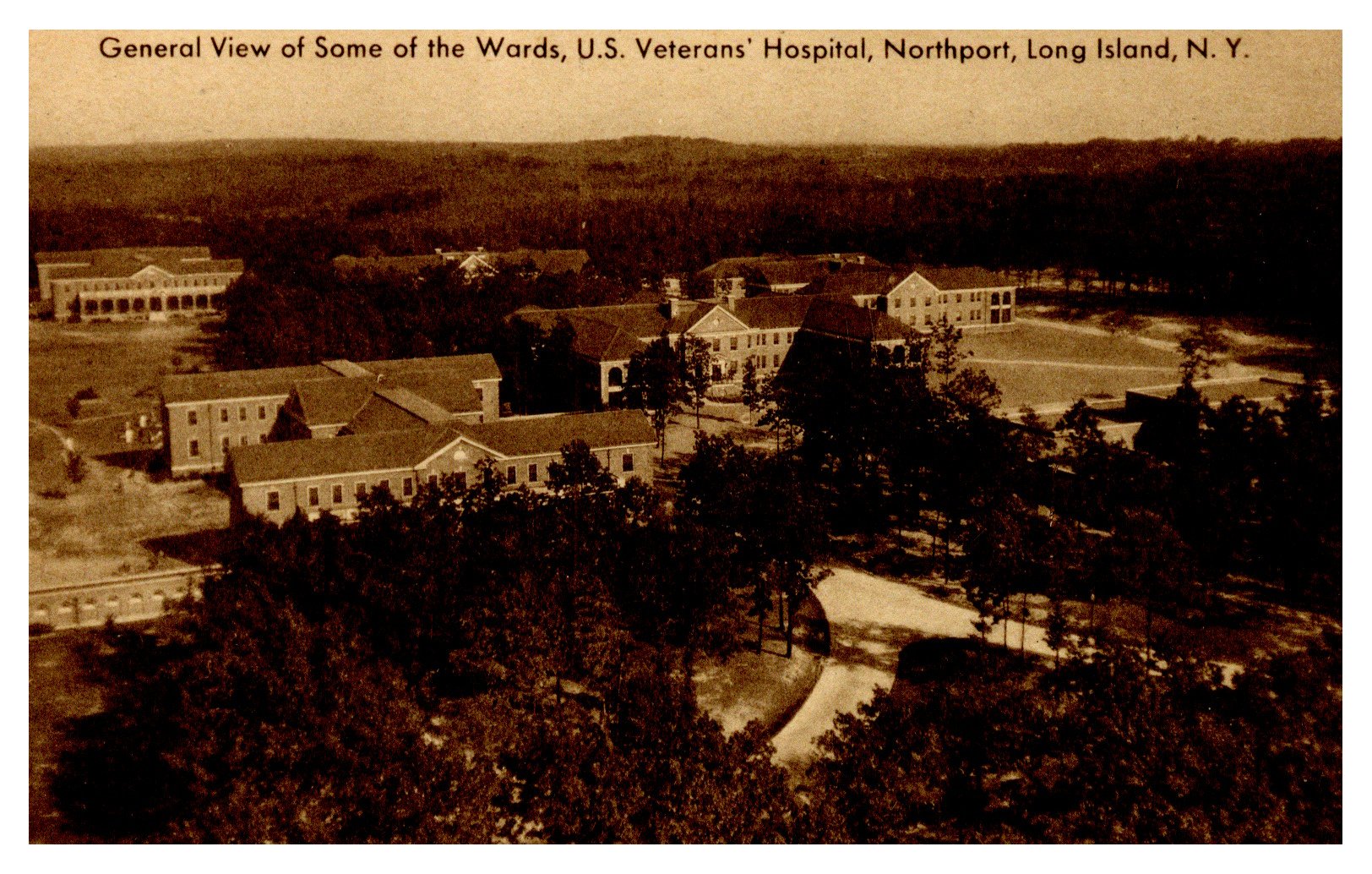
Shortly after WWI, it became apparent to Congress that the returning veterans were not able to obtain the proper medical and psychological treatment they needed and deserved. To rectify this situation, President Harding established the US Veterans Bureau in 1921, which assigned Public Health Service hospitals to the new agency’s control.
Under the supervision of Brigadier General Frank T. Hines, a committee was formed to choose a site in the New York area for a new modern and specialized health care facility. In 1925, the committee, after scouting hundreds of locations in the tri-state area chose the small, picturesque village of Northport.
Residents, having learned plan to purchase 522 acres of farmland in the Middleville area, rallied together in protest. Public hearings were held where citizens voiced their concerns about another such hospital, like the one in King’s Park and Islip, coming to Suffolk County. The people in attendance thought land values would decrease, businesses would suffer, and traffic would stress the small unpaved roads. A resolution was drawn up and sent to the NY Representatives. Two weeks later, a delegation from Northport led by Mr. R. B. Jones, went to Washington DC and appeared before the Federal Board of Hospitalization. Among the list of disputes: the land was too expensive. Why had the Federal Government paid $350 an acre, double the going rate?
The property once owned by Rinaldo Sammis (hence Rinaldo Road), was then owned by Mrs. Inez Todd Hodges. Just before the land purchase though, the land became the property of rich and powerful copper industrialist Ryan, who had made a fortune during the war. It seems that, for reasons unknown, Mrs. Hodges was in debt to Mr. Ryan for over $100,000. They struck a deal. He would sell the land for her to pay off her debt and anything over the debt amount, would be extended to her. Ryan sold the property to the government at the inflated price, perhaps because of powerful friends doing a favor, Mrs. Hodges never saw a dime, and Northport resident’s concerns fell on deaf ears.
Construction began in August of 1926. The plan of the Medical Center is based on the standard set plan developed by the Veterans Bureau in Washington DC for all such facilities in the U.S. Between 1920 and 1946, the Bureau built 50 Veterans’ hospitals across the country, constituting the most ambitious and most advanced health care delivery system in the world at the time.
The original Medical Center in Northport was built for $3,386,518. The 956-bed facility offered a campus-like setting with beautiful landscaping, out-door recreational facilities and paved roadways. The exterior design was approved at the highest level of the VA in Washington but reflected the historical nature of Northport Village. Thus, the style selected, Georgian Colonial home, is unique among the VA system.
The first patients were admitted on April 16, 1928 with Doctor George F. Brewster as the Medical Officer in Charge and the Center soon became a source of pride for Northport.
Patients received the most current treatments and therapies of the time, there were no bars on the windows, there was a swimming pool, large porches, and community dining rooms. All the cooking was done with electricity in the large kitchen. A large recreation room seated 1,000 patients, contained a stage, scenery, and dressing rooms. The Center was equipped with x-ray machines, a research lab, and an operating room. Dental care was also offered. It became its own little community, with farms, a fire department, general store, mechanic shop and its own baseball team, the “Wildcats.”
Patients were kept busy with occupational and agricultural therapeutic programs, such as carpentry, textile making, painting and farming. They ate the fresh vegetables they grew, including potatoes. They also had “chores” taking care of gardens or working in the stables. Chickens, pigs and sheep were raised for research purposes. Many of these programs lasted until the 1960s.
During WWII, many activities were curtailed due to fuel shortages, however the hospital maintained a “Victory Garden.” Many employees joined the armed services and as a result military personnel were assigned to fill the vacancies. One of the enlisted men assigned to the hospital was actor Sidney Poitier. After the war the hospital’s ecumenical chapel was built as a gift from the readers of the New York Journal American.
In the 1950s, Northport’s hospital was one of the first psychiatric hospitals to treat patients with newly discovered drugs and was pioneering programs like group therapy and community out-placement, earning them an award for its accomplishments. After the Korean and Vietnam Wars the increasing number of veterans forced the Medical Center to expand, providing general medical and surgical care. Many new buildings were constructed, and the farm-setting community atmosphere changed dramatically, however, patient care was always their number one goal.
In the decades that followed, the Northport Veterans Medical Center has had to continually adapt to change as it finds itself doing once again during the Covid-19 Pandemic. On March 27th the VA released its Covid-19 response plan and announced its “Fourth Mission”, a plan to help the U.S. combat the virus.